 Department of Germanic Languages & Literatures University of Toronto
Intercultural Skills in Strong Demand Among Employers
by Angelica Fenner, Associate Chair of Graduate Studies
As the world catapults into an era of strained international relations, the need for intercultural sensitivity and respect has become all the greater. The Humanities have a vital role to play in upholding the enduring value of clear, concise language and lucid reasoning— key skill sets fostered through exploring facets of the human (and more-than-human) condition from disparate subject positions and historical vantage points. Language and Literature departments, in particular, remain an important locus for teaching communication across cultural difference, and for inspiring on openness to the world alongside heightened reflexivity about discourse, culture, and society.

This past year our graduate students travelled widely in pursuit of these skills. With funds from DAAD, the Joint initiative in German and European Studies, and our department several doctoral students travelled abroad for research and/or advanced language and culture immersion. Tamara Schaad enrolled the popular Canadian Summer School in Germany (CSSG), which included a two-month stay with a host family, while Hannah Robinson attended the 29th Internationale Sommerakademie at Martin-Luther Universität Halle-Wittenberg. Doctoral candidate Astrid Klee secured JIGES funds for archival research in Heidelberg and Munich towards her thesis research, “Representations of Mental Illness in the Patient Cases of Emil Kraepelin’s Einführung in die psychiatrische Klinik.”
Others disseminated research at conferences across North America. In February, Miriam Schwartz travelled to the University of Texas at Austin to deliver the talk “Immigration and Jewish Multilingualism in S.L. Blank’s The Island of Tears” at the conference “Decentering Jewish Literature in the Americas.” In March, Rita Laszlo attended a graduate research colloquium at the Northeast MLA convention in Philadelphia, where participants exchanged feedback on pre-circulated thesis chapters. In May, Miriam Borden attended the conference “Music, Sound, and Antisemitism” held at CUNY’s Barry Brook Center for Music Research and Documentation under sponsorship by the Center for Jewish History.
Accolades go out to Hannah Robinson, who secured the 2025 German Studies Canada Best MA Thesis Prize for last year’s major research paper (MRP), “Transgressive Translation: Examining Perceptions of Multilinguals as Boundary-Crossers in Wolfram von Eschenbach’s Willehalm.” This stellar manuscript reflects an inquisitive mind and nimble writing skills supported by excellent supervision received from Prof. Markus Stock and affiliate faculty and multilingualism expert, Prof. Enrica Piccardo. In turn, Sophie Jordan’s masterful research proposal, “Black Arthurian Knighthood in the Medieval Dutch Moriaen” has been recognized with a Mary A. Beatty Fellowship for the academic year 2025-26. Hannah Wickham passed the Qualifying Exams for the Yiddish Stream, and Jacob Hermant achieved candidacy with the thesis proposal “Reading Literature as Philosophy in the Yiddish Haskalah,” approved by supervisor Prof. Anna Shternshis and committee members Willi Goetschel and Naomi Seidman.
Last Spring, we closed the academic year with the annual graduate research colloquium, which included MA student Lesley Turner’s presentation Mourning the “Night of the Murdered Poets”: A Call to Reconfigure the Canon, on Yiddish poet and short story writer Chava Rosenfarb, who was sent to the Gulag during Stalinist purges of Yiddish culture. Doctoral students Tamara Schaad elaborated the intertextual reworkings of Undine in Representation and Choice: The Mythical Figure Undine in Four Fairy Tales, 1811–2020 and Jacob Hermant identified an ecological consciousness in Gender, Land, and Folk in Schloyme Ettinger’s Serkele.
Two further candidates earned the Doctor of Philosophy over the summer. On April 14, Andre Flicker passed the Final Oral Exam with his thesis, Dada’s Unsinn: The Negation of Meaning and Sense in Zurich and Berlin Dada supervised by Prof. Willi Goetschel with committee members Professors Rebecca Comay and John Zilcosky, internal external examiners Professors Christine Lehleiter and John Noyes, and exam chair Professor Cara Krmpotich. External examiner Prof. Brodsky described Dr. Flicker’s nearly 400-page tome as “magisterial” and “extraordinarily comprehensive in its empirical and historical investigation of the two successive centers of Dada creativity in Europe.” Congratulations, André! We are fortunate to welcome you back in Fall 2025 to assist with coordination of the language program while Professor Gargova takes a well-deserved semester sabbatical.
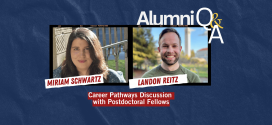
In turn, on August 19 Miriam Schwartz similarly sailed through her Final Oral exam with flying colours. The exam committee encompassed supervisory members Professors. Anna Shternshis (supervisor), Naomi Seidman, and Allison Schachter, with Pofessors Willi Goetschel and Yigal Nizri serving as internal externals, Dr. Mikhail Kruikov (Michigan) as external examiner, and Dr. Ann Komaromi presiding as Exam Chair. Miriam’s thesis, Dubbed Jewish Literature: Multilingualism, Translation, and Hopelessness in Twentieth-Century Hebrew and Yiddish Writing, encompasses key texts from the early to mid-twentieth century across Eastern Europe, the Middle East, and North and South America, with the aim of exploring authorial strategies for conveying via ‘dubbing’ specifically oral speech from foreign languages in writings in both Hebrew and Yiddish. Dr. Krutikov describes her research as an “insightful and far-reaching analytical study of a largely neglected phenomenon.” Miriam will surely savour her newly minted status, but she won’t get to rest for long, as she is already embarking on the next promising chapter in her career, taking up a two-year postdoctoral fellowship at Dartmouth College in September! We wish her every success in the dynamic setting that Dartmouth has to offer.
Amid a flurry of students graduating, our ranks are also replenishing. This Fall we are delighted to welcome Sam Hacker, who will pursue MA studies in the Yiddish stream parallel to continuing student Lesley Turner. In the doctoral program, we welcome Max Weber, who comes to us with an M.A. earned from the Humboldt-Universität Berlin, as well as Eliza Auten, who recently graduated from Smith College with majors in German and in Jewish Studies.