 Department of Germanic Languages & Literatures University of Toronto
New Book on Plurilingualism by Professor Enrica Piccardo
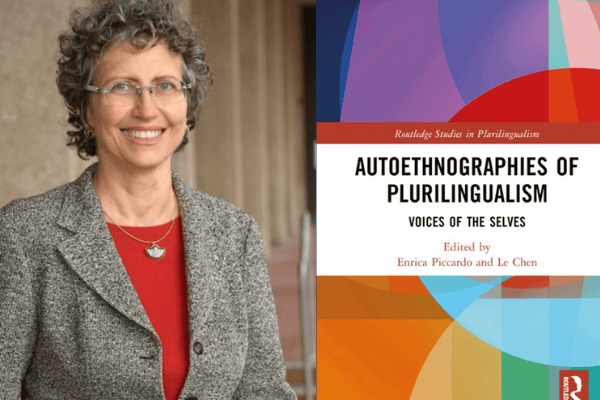
Our department is wonderfully enriched by the contributions of affiliate faculty whose expertise in cognate units such as history, Jewish Studies, and Sociology supports the interdisciplinary researches of our doctoral students. One such scholar is Enrica Piccardo, Professor of Applied Linguistics and Language Education in the Languages and Literacies Education Program at the Ontario Institute for Studies in Education (OISE). She serves as Director of the Centre for Educational Research in Languages and Literacies and also as distinguished Maître de Conférences (Associate Professor) at the Université Grenoble-Alpes (France). Her internationally recognized research is centred around Second/Foreign Language learning and teaching, plurilingualism and mediation, the impact of the Common European Framework of Reference (CEFR) on language teaching and assessment, complexity theories, and creativity in language acquisition.
Together with collaborator Le Chen, she recently published the volume Autoethnographies of Plurilingualism: Voices of the Selves (Routledge, 2024) which offers a theoretically grounded and methodologically innovative examination of the complex trajectories and identities of plurilingual speakers. Through a rich collection of personal narratives, the volume invites readers to witness how language users navigate, negotiate, and reimagine their linguistic repertoires, thus transcending conventional notions of language competence. As such, it also provides new insights into the humanistic, philosophical, and functional dimensions of plurilingualism. In the introductory chapter the editors outline the book’s twofold aim: addressing gaps in the study of plurilingualism by both elucidating key theoretical principles and foregrounding the value of personal narratives and autoethnographic approaches. In the concluding chapter they synthesize emergent themes from the narratives and their connections to the foundational principles of plurilingualism. A rich afterword by Joseph Lo Bianco addresses the narratives and autoethnographies as informative and illustrative, and more importantly, as emotionally and morally moving. The book is a critical resource for researchers, practitioners, and policymakers who seek to understand and foster more inclusive, dynamic, and meaningful approaches to language education.