 Department of Germanic Languages & Literatures University of Toronto








Welcome to the Future of German Studies
The Department of Germanic Languages and Literatures is committed to the four C’s of critical thinking, creativity, collaboration, and communication – 21st Century skills that are crucial for navigating the realities of a complex, increasingly intertwined, and rapidly changing world. Our goal – and the challenge to the humanities in light of a global climate crisis, technological disruption, and political instability – is to equip students to understand, problem-solve, and cooperate across the intricacies of language, culture, and time zones.
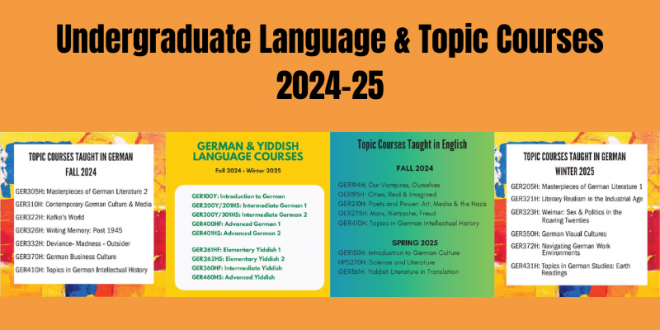
Our department offers innovative undergraduate programs and learning pathways in German, Yiddish, Global Studies, and Business German, and M.A. and Ph.D. degrees in German Literature, Culture, and Theory, including a unique M.A. concentration in Yiddish Studies. Students are mentored by inspiring faculty with extensive training in German and Yiddish languages and literature, Comparative Literature, Film Studies, Philosophy, Jewish Studies, Medieval Studies, and Environmental Humanities, and we maintain vibrant connections to other departments, interdisciplinary centres, and international networks.
We see the classroom as a launch pad. Our iPRAKTIKUM experiential learning and internationalization infrastructure creates exciting opportunities for students to extend and deepen academic knowledge and competencies in local and global contexts. We are particularly proud of our sustainability and social innovation-focused futurGenerator program in Freiburg, where U of T students engage in rewarding work in areas like migrant integration, environmental education, and food security. They also have a lot of fun!
We strive for inclusive excellence. This means appreciating the potential of people of diverse backgrounds in terms of their ethnicity, race, socio-economic status, religious belief, national heritage, gender identity and sexual orientation, age, and ability. Operating in a Canadian context, we are particularly sensitive to the history of the traditional lands on which we carry out our educational mission and the ongoing impact of colonial settlement on indigenous peoples.
This is 21st Century German Studies at the University of Toronto.
Stefan Soldovieri, Chair